Science and genetics
How features are inherited and how faces are studied. 27 face guides on EveryFaceShape so far.
Science studies how faces form, how features are inherited and how people perceive faces. Embryology explains the philtrum and Cupid's bow; genetics explains eye colour and freckles; psychology studies symmetry and averageness. Science also shows what is not true: physiognomy, the old idea that faces reveal character, has no basis, and golden-ratio beauty claims are not well supported.
Growth and genes
The face forms in the embryo from several swellings of tissue that grow and fuse; the philtrum and Cupid's bow mark where they meet at the upper lip. Eye colour, freckling and many other traits are shaped by multiple genes, with OCA2, HERC2 and MC1R among the best known. Most features do not follow the simple single-gene patterns of older textbooks.
Perception
In 1990 Judith Langlois and Lorri Roggman reported that composite faces, blended from many photos, were rated attractive, a finding called averageness. Studies also find a modest preference for symmetry, though no face is perfectly symmetric. Claims that beautiful faces follow the golden ratio have not held up well. Physiognomy, used in the nineteenth century to support racist theories, is not science.
Famous science and genetics face guides

Still to be written: Averageness.
Further reading
 WorldIris
The coloured ring in the eye that controls light entry.Eyes · Most faces
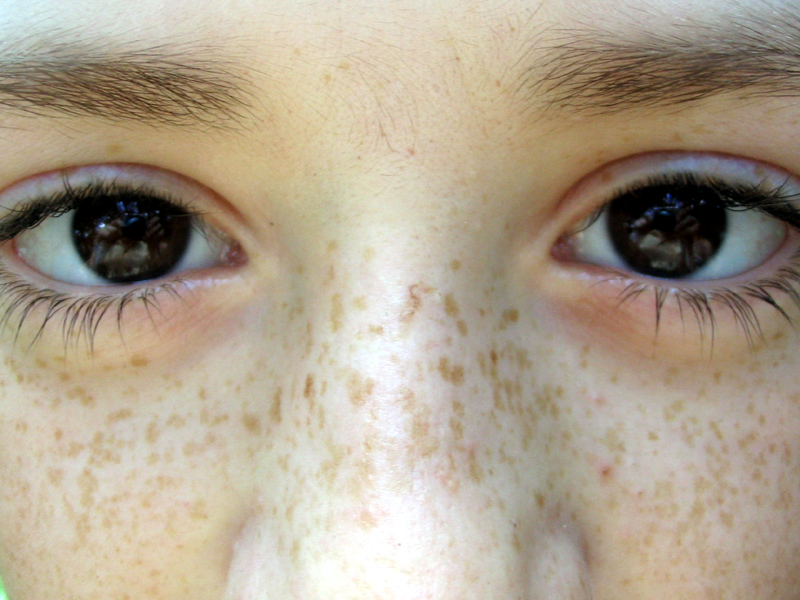 WorldFreckles
Small clusters of concentrated melanin on the skin.Skin · Most faces
 WorldLimbal ring
A dark band encircling the outer edge of the irisEyes
 WorldSclera
The tough outer coat that creates the pale background of the eyeball.Eyes · Most faces
WorldCanthus
The inner and outer corners where the eyelids meet at the eye.Eyes
 WorldAngle of the mandible
The bony corner where the jaw's vertical and horizontal sections meet.Jaw and cheeks
 WorldBlushing
The involuntary reddening of the face caused by emotional stress.Skin
 WorldChin
The forward-pointing lower section of the jawbone below the mouth.Jaw and cheeks
WorldTriangular face
A face shape where the lower half narrows to a point, resembling an inverted triangle.Face shape
 WorldWidow's peak
A V-shaped point in the centre of the forehead hairline.Hairline · Most faces
 WorldZygomatic bone
The paired irregular bone forming the cheek and part of the eye socket.Face shape · Most faces
 WorldMonolids
An upper eyelid form without a visible crease, common in East Asian populations.Eyes
 WorldNostril
The two openings of the nose that allow air to enter and leave the body.Nose · Most faces
WorldMalar region
The triangular cheekbone area of the human face.Jaw and cheeks
 WorldNasion
A natural dip in the bone structure between the eyes and the top of the nose.Nose
 WorldEpicanthic fold
A vertical skin fold at the inner corner of the eye.Eyes · Most faces
 WorldEyelash
Hairs lining the eyelid edges that protect the eye and frame the gaze.Eyes · Most faces
 WorldForehead
The area of the head above the eyes and below the hairline.Hairline
 WorldEye color
The natural variation in human iris hue driven by melanin and light scattering.Eyes · Most faces
 WorldFacial symmetry
The balance of features on the left and right sides of a human face.Skin
 WorldBrow ridge
The bony crest above the eye sockets that supports facial structure and protects the eyes.Brows
 WorldUnibrow
A single eyebrow formed by hair meeting above the nose bridge.Brows · Most faces
 WorldVermilion border
The sharp line where lip colour meets facial skin.Lips · Most faces
🇮🇱 Israel and 2 moreButton nose
A small, rounded nose with an upturned tip.Nose · Most faces
WorldCleft chin
A natural indentation in the centre of the chin.Jaw and cheeks · Most faces
Photo credits on this page
The small pictures above come from Wikimedia Commons under free licences. Some are cropped to fit.
- Nasion: Unknown author, Public domain, source
- Epicanthic fold: Sarang, Public domain, source
- Limbal ring: Chianti, FAL, source
- Sclera: Jo Naylor, CC BY 2.0, source
- Angle of the mandible: Polygon data is, CC BY-SA 2.1 jp, source
- Blushing: Valerie Hinojosa, CC BY-SA 2.0, source
- Iris: Rossche, CC BY-SA 4.0, source
- Freckles: Loyna, CC BY-SA 2.5, source
- Eyelash: Rapidreflex, CC BY-SA 4.0, source
- Forehead: Faceofwiki, Public domain, source
- Eye color: LeuschteLampe, Public domain, source
- Philtrum: Rick Kimpel, CC BY-SA 2.0, source
- Facial symmetry: Hermann Braus, Public domain, source
- Brow ridge: Falbygdens museum, CC BY-SA 1.0, source
- Chin: User:Tizio cropped the original to show just the cleft chin, to be sho, Public domain, source
- Widow's peak: Kuebi = Armin Kübelbeck, CC BY-SA 3.0, source
- Zygomatic bone: Anatomography, CC BY-SA 2.1 jp, source
- White roll: Original: Genusfotografen (Tomas Gunnarsson) Modified: Own work, CC BY-SA 4.0, source
- Monolids: Unknown author, Public domain, source
- Nostril: Kuebi = Armin Kübelbeck, CC BY-SA 3.0, source
- Unibrow: Z11o22, CC BY-SA 3.0, source