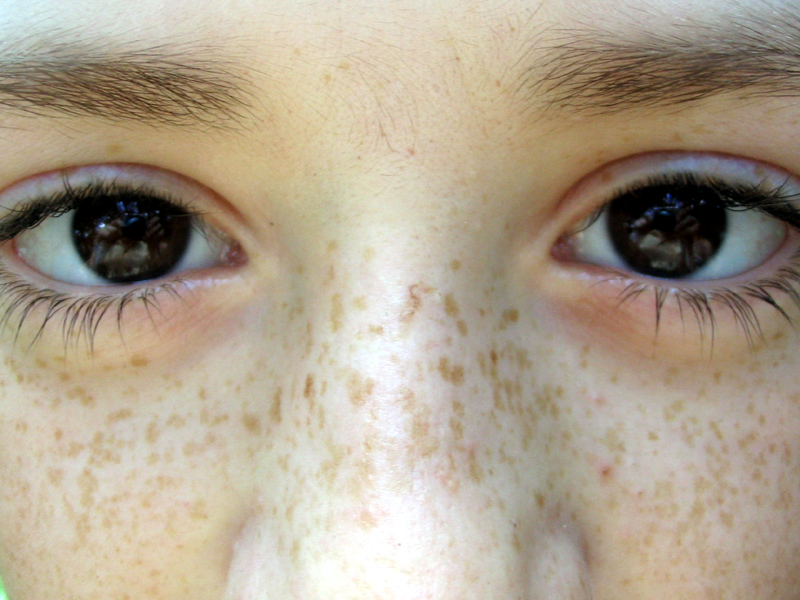
Freckles
Small clusters of concentrated melanin on the skin.
Freckles are flat, light brown or red spots caused by melanocytes overproducing melanin granules. They appear most often on fair skin after sun exposure and are linked to variants of the MC1R gene.
- Caused by melanocytes overproducing melanin granules.
- Linked to variants of the MC1R gene.
- Most common on Fitzpatrick skin types 1 and 2.
- Became fashionable in the late 20th century.
- Fade with age and reduced sun exposure.
What it is
Freckles are small clusters of concentrated melaninized cells visible on the skin. They do not result from an increased number of melanin-producing cells. Instead, existing melanocytes overproduce melanin granules, which change the colour of outer skin cells. These spots are flat and typically light brown or red. They differ from moles and lentigines, which involve an accumulation of melanocytes in a specific area. Freckles can appear on any skin tone but are most easily seen on fair complexions.
History and origin
The genetic variants linked to freckles emerged as humans migrated out of Africa. The Val92Met variant arose between 250,000 and 100,000 years ago, allowing the gene to spread into Asia. Other variants like Arg160Trp appeared around 80,000 years ago. In Western societies, freckles were once viewed as imperfections or spiritual stains. This perception shifted in the mid-20th century when tanning became a status symbol. By the late 20th century, figures like Twiggy helped make freckles fashionable.
What it means
Historically, some cultures viewed freckles negatively. Pliny the Elder described them as religious stains. Later, they became associated with leisure and youth during the 1960s youthquake movement. In recent years, social media trends have popularised freckle tattoos, mimicking the natural look. They are now often seen as a desirable feature in fashion and advertising rather than a flaw.
The science
Freckle formation is driven by exposure to UV-B radiation, which activates melanocytes. Genetics play a key role, specifically rare alleles of the MC1R gene. Variants such as Arg151Cys and Asp294His are common in those with freckles. This gene is also linked to red hair and light skin, adaptations that help synthesise vitamin D in lower UV environments. People with freckles often have less photo-protective melanin.
Styling and care
Regular use of sunblock can inhibit the development of new freckles. They are most common on the face, arms, and shoulders. Freckles may fade with age or reduced sun exposure. If altered by lasers or creams, they will reappear without sun protection. They are rare in infants and more common in children before puberty.


Questions people ask about Freckles
What causes freckles to form?
Exposure to UV-B radiation activates melanocytes to increase melanin production. This process is influenced by genetics, specifically variants of the MC1R gene, which cause cells to overproduce melanin granules.
Are freckles the same as moles?
No. Freckles do not have an increased number of melanin-producing cells. Moles and lentigines are caused by an accumulation of melanocytes in a small area, whereas freckles are just concentrated pigment.
Can freckles be prevented?
Regular use of sunblock can inhibit their development. Since UV exposure triggers melanin production, protecting the skin from the sun helps prevent freckles from becoming darker or more visible.
Do freckles go away with age?
They can fade with age in some cases. They also fade with a reduction in sun exposure. However, if they have been altered by treatments and the skin is exposed to sun again, they may reappear.
Good reading and sources
The facts on this page come from the Wikipedia article "Freckle", written by its contributors and used under the CC BY-SA 4.0 licence, and from its Wikidata record (CC0). EveryFaceShape rewrote the text in its own words, with AI assistance, and compares every page with the article to make sure no passage is copied. It may be reused under the same CC BY-SA 4.0 licence with a link back.
It may contain mistakes, and figures change over time. Nothing here is investment or buying advice. If something is wrong, tell us. Last refreshed 2026-11-15.
Like Freckles
All skin features WorldBlushing
The involuntary reddening of the face caused by emotional stress.Skin
 WorldDimple
A small natural indentation in the flesh, most notably on the cheek.Skin · Most faces
 WorldUnibrow
A single eyebrow formed by hair meeting above the nose bridge.Brows · Most faces
 WorldBeauty mark
A dark facial mark, natural or applied, worn for adornment.Skin · Most faces