Lips and mouth
Full, thin and bow-shaped lips, the Cupid's bow and the philtrum. 6 face guides on EveryFaceShape so far.
Lips come full or thin, wide or narrow, with a sharp or soft Cupid's bow. Above the upper lip runs the philtrum, the small groove beneath the nose. Lip shape is inherited and varies within every population; fashions for one shape or another have come and gone. Lips have been coloured with plant dyes, ochre and safflower for thousands of years, and in some traditions pierced or tattooed.
Bow and groove
The Cupid's bow is the double curve at the centre of the upper lip; its two peaks sit at the bottom of the philtral columns, the ridges of the philtrum. Both form in the embryo where tissue growing from each side of the face meets in the middle. The vermilion is the red part of the lip, and its edge, the vermilion border, is the line lipstick and liner follow.
Lips in tradition
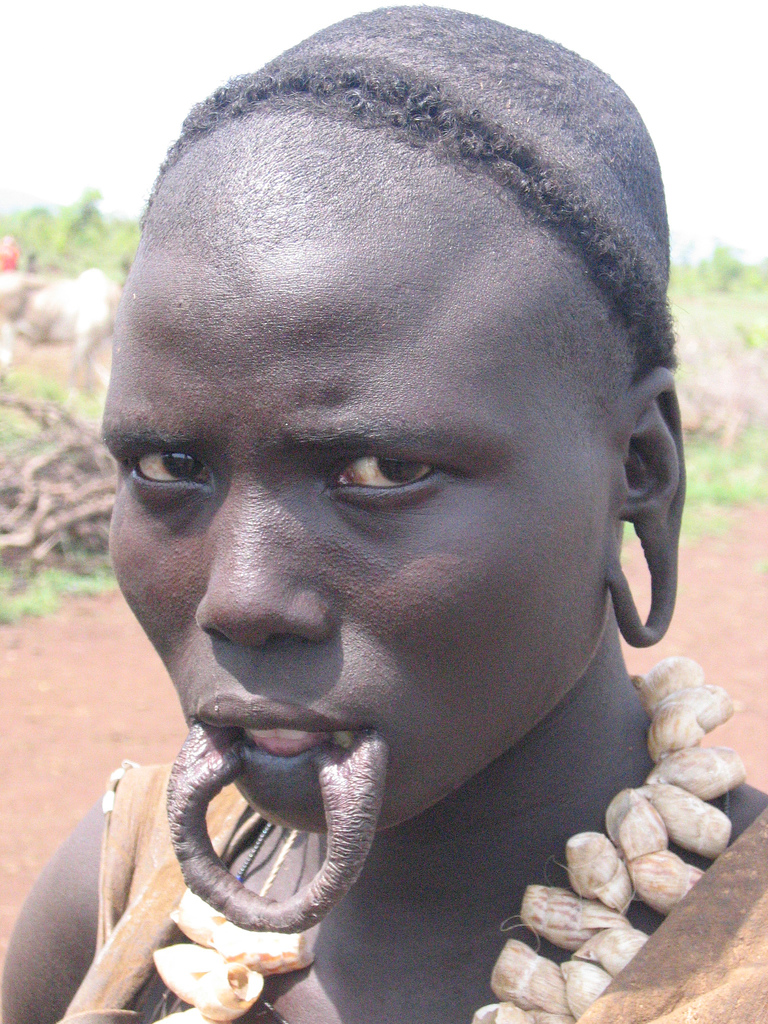
Lip colour is old: Sumerian and Egyptian women used crushed stones and dyes, and Edo Japan used beni from safflower. Ainu women of Hokkaido were tattooed around the mouth until a ban in 1871. Labrets, ornaments worn in a lip piercing, were worn by Aztec nobles, Tlingit and Haida women and Inuit men, and Mursi women of Ethiopia wear clay lip plates.
Famous lips face guides


Further reading
 WorldLip
Soft, movable tissue forming the visible opening of the mouth in humans and many animals.Lips
 WorldCupid's bow
The double curve of the upper lip resembling an ancient bow.Lips
 WorldWhite roll
The white line bordering the top of the upper lip.Lips
WorldVermilion border
The sharp line where lip colour meets facial skin.Lips · Most faces
WorldFull lips
A lip shape with equal volume on top and bottom.Lips · Most faces
WorldThin lips
A lip shape with less volume and definition.Lips · Most faces
Photo credits on this page
The small pictures above come from Wikimedia Commons under free licences. Some are cropped to fit.
- Labret: Metalhead64, CC BY-SA 3.0, source
- Lip plate: Monkeyji, CC BY 2.0, source
- Lipstick: Sjr, Public domain, source
- Philtrum: Rick Kimpel, CC BY-SA 2.0, source
- Cupid's bow: Gage Skidmore, CC BY-SA 2.0, source
- White roll: Original: Genusfotografen (Tomas Gunnarsson) Modified: Own work, CC BY-SA 4.0, source