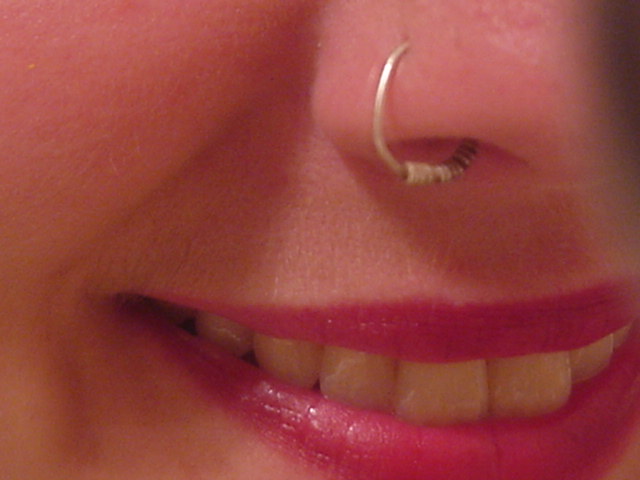
Nose piercing
A facial adornment involving jewelry inserted into the nose skin or cartilage.
This practice pierces the skin or cartilage of the human nose to wear jewelry. It appears in many cultures as a symbol of beauty, identity, or tradition, with origins traced to the Middle East and Ancient Israel over four thousand years ago.
- Nostril piercing is the most common variety of nose piercing.
- Septum piercings heal faster than nostril or bridge piercings.
- Historical records trace the practice to the Middle East over 4000 years ago.
- In Egypt, specific regional names like Khuzam and gatar describe different styles.
- Bridge piercings carry higher risks of migration and scarring.
What it is
A nose piercing involves creating an opening in the nose to hold jewelry. The most common type is the nostril piercing, which goes through the soft tissue of the nostril. Other varieties include septum piercings, located in the flexible skin between the cartilage and the bottom of the nose, and bridge piercings, which pass through the skin between the eyes. Jewelry options range from studs and rings to barbells and retainers. The choice of placement affects both appearance and healing time.
History and origin
Written evidence of this practice appears in the Hebrew Bible. Historians suggest it began in the Middle East more than four thousand years ago before moving to India by the fifteenth century. In the Americas, pre-Columbian carvings show nose piercing rituals indicating high social status among Maya leaders. By the twentieth century, the practice reached Western civilization, initially gaining traction in punk subcultures during the 1960s before becoming globally popular.
What it means
Across diverse societies, nose piercings symbolize beauty, identity, and tradition. In South Asia, they are often associated with married women among both Hindus and Muslims. Among the Arunta people of Central Australia, septum piercing marks a boy's transition to manhood and a girl's marriage. In ancient Carthage and various Native American tribes, such piercings denoted leadership, social standing, or ceremonial rights.
Styling and care
Healing times vary by location: nostril and bridge piercings take three to four months, while septum piercings heal in one and a half to two months. Septum jewelry can be flipped up for concealment, making it suitable for professional environments. Proper aftercare is essential to prevent infection. Piercers recommend using sterile needles and avoiding water sources like pools during healing to minimize health risks.


Questions people ask about Nose piercing
How long does a nose piercing take to heal?
Healing depends on the location. Nostril and bridge piercings typically take three to four months to fully heal. Septum piercings heal faster, usually within one and a half to two months, provided proper care is taken.
What types of jewelry are used for nose piercings?
Common options include nose studs, nose bones, circular barbells, curved barbells, and captive bead rings. For septum piercings, retainers can be flipped up to hide the jewelry, while plugs are often chosen for larger gauges to reduce weight.
Where did nose piercing originate?
The practice originated in the Middle East more than four thousand years ago. Earliest written evidence appears in the Hebrew Bible. It later migrated to India and reached Western civilization by the twentieth century.
Are there cultural meanings behind nose piercings?
Yes, meanings vary widely. In South Asia, they often signify marriage. Among some Indigenous Australian groups, they mark rites of passage for men and women. In ancient Maya society, they indicated elevated social status and leadership roles.
Good reading and sources
- Nose piercing on WikipediaEncyclopedia
- More photos on Wikimedia CommonsPhotos
- Wikidata recordOpen data
The facts on this page come from the Wikipedia article "Nose piercing", written by its contributors and used under the CC BY-SA 4.0 licence, and from its Wikidata record (CC0). EveryFaceShape rewrote the text in its own words, with AI assistance, and compares every page with the article to make sure no passage is copied. It may be reused under the same CC BY-SA 4.0 licence with a link back.
It may contain mistakes, and figures change over time. Nothing here is investment or buying advice. If something is wrong, tell us. Last refreshed 2026-11-15.
Like Nose piercing
All adornment 🇮🇳 IndiaTilaka
A traditional Hindu forehead mark applied with paste or ash to signify faith and spiritual identity.Adornment
 WorldCheek piercing
A facial piercing through the cheek tissue to create a dimple-like appearance.Adornment
 🇮🇳 India and 4 moreBindi
A coloured dot worn on the forehead in South and Southeast Asia.Adornment · Most faces
 🇮🇱 Israel and 2 morePe'ot
Sideburns left uncut above the cheekbone as required by Jewish law.Beard · Most faces